Demo

A fleet tracking demo on your vehicle, not on someone else's data

We put tracking on one vehicle from your fleet with the full configuration — geofences, alerts, reports. A week later you are looking at your own routes, your own stops and your own numbers, and only then decide about scale.

Request a free quote Updated: September 12, 2026

One vehicle, full setup

Not a cut-down trial. Geofences, alerts and reports configured the way a real rollout would be.

Live in 48 h

From the first call to data on the map, provided the vehicle is available for fitting.

Your data, not samples

A demo on someone else's fleet shows what the platform can do. A demo on yours shows what you will actually use.

Quote in 24 h

The fleet-wide quote is prepared in parallel, so the decision does not wait on a separate process.

What is included

Exactly what you get for the trial

Not a cut-down trial. A Wialon account and a configuration identical to the production one — otherwise the test does not answer the question you are asking.

Geofences

For the locations that actually matter: your base, customer warehouses, restricted zones.

Alert scenarios

Leaving a zone, speeding, power disconnection, engine running while parked.

Report templates

Mileage, working time, stops, driving style — in the shape the person reading them needs.

Mobile account

For the driver or the manager, if that is part of the target setup.

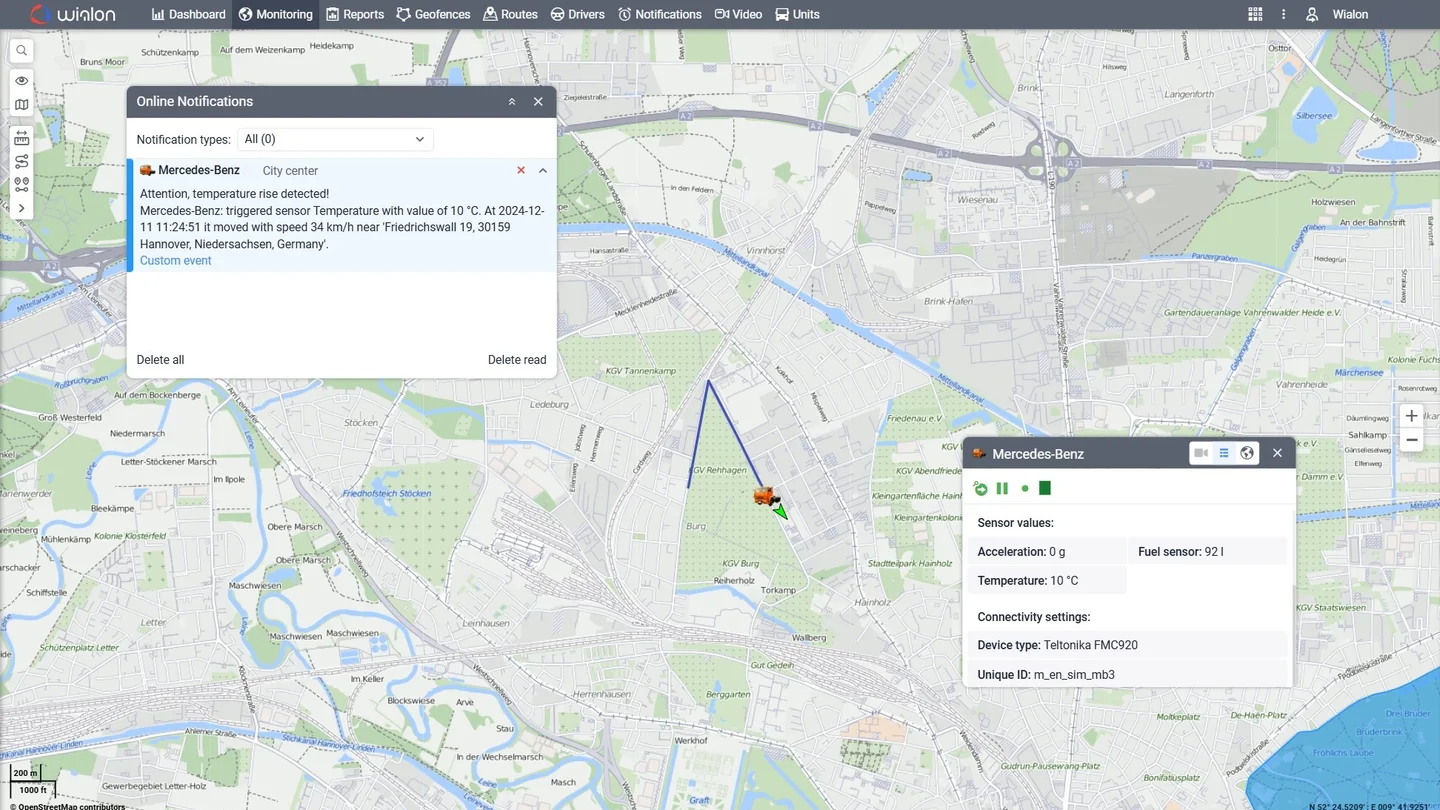
Wialon — Monitoring panel — map, vehicles and events

If the vehicle has a CAN bus or an OBD port, we also connect the on-board readings — fuel level, engine speed, temperatures. Without them the demo shows routes but not costs, and costs are usually what this is really about.

Your own vehicle

Three things you cannot see on someone else’s data

A demo on another company’s fleet answers "what can the platform do". A demo on yours answers "what will we actually use".

The quality of your routes

Road types, trip length and stops per day decide which reports make sense for you. A distribution fleet with forty drops a day reads entirely different reports than a service fleet with three call-outs.

How your team reacts

An alert nobody acts on is a cost, not a feature. A week is enough to see whether notifications reach somebody who opens them.

The real spread

Two identical vehicles on similar routes can differ by over ten per cent in consumption. That is the number a decision rests on, and it cannot be borrowed from another company’s case.

Schedule

From enquiry to first data: 48 hours

The right-hand column is how much of it lands on you. The rest is on us.

  1. Day 0

    Call

    We agree what you want to verify and which vehicle is representative.

    30 minutes
  2. Day 1

    Configuration

    Account, geofences, alerts and reports — ready before the vehicle appears on the map.

    nothing
  3. Day 1–2

    Installation

    An OBD tracker plugs in within minutes; a two-wire unit needs a quarter of an hour standing still.

    vehicle downtime
  4. Week 1–4

    Review

    Once a week we go through the data together: what shows up, what thresholds need correcting, what is missing.

    4 × 30 minutes
Your total time

About three hours spread over a month, plus one stop for the installation.

Criteria

Four questions the demo has to answer

Write them down before the start, not after. A demo without criteria ends in an impression rather than a decision.

  1. 1

    Can the report that feeds billing be generated without manual work in a spreadsheet?

  2. 2

    How many alerts a day does one vehicle produce, and how many needed a real response?

  3. 3

    Does the mileage from the system match the odometer and the fuel invoices?

  4. 4

    Who in the company actually opened the panel during the week, and what for?

A system nobody opens during the demo does not start being used after the contract is signed.

The fourth question tends to be the most uncomfortable and the most useful. If the demo goes badly, that is an answer too — better to get it on one vehicle than on forty.

Most tracking-system demos look the same. Someone shares a screen, vehicles belonging to another company move across a map, and the charts show metrics with nothing familiar to compare them to. You leave knowing the platform has a lot of features. You do not leave knowing which of them solve the problem you came with.

So we run the demo differently: one vehicle from your fleet, configured as if the rollout had already started.

Which vehicle to pick

A typical one, not the best one. Average mileage, routes representative of the fleet, and a driver who is not more aware of being watched than usual. A demo on the best-run vehicle produces results that cannot be repeated at full rollout — and that is the most common mistake at this stage.

If the fleet is not uniform, two vehicles beat one: a suspect one and a reference one. Comparing two vehicles on similar routes says more than the chart of a single one, because it shows the spread rather than an absolute value. With a mixed fleet — cars and trucks — take one of each, because installation, the range of available readings and the reports that make sense differ more between those categories than between brands.

The duty to inform applies during a trial too

A trial period is not an exemption from the rules. From day one you need the monitoring recorded in the work rules or an official notice, the employee informed in advance, and the vehicle marked. That holds for one car over two weeks as much as for a whole fleet.

We help prepare the wording, because this is the most common reason a demo stalls — not the technology, but the missing basis for switching it on. In Poland the requirement follows from the Labour Code and the GDPR.

What happens to the data and the hardware afterwards

If you go ahead with the rollout, the tracker stays in the vehicle and joins the order, and the configuration — geofences, alerts and reports — moves to the production account. You do not start from an empty screen and you do not lose weeks of setup.

If you do not, we collect the device and close the demo account. Trial-period data is deleted on request immediately, and otherwise when the account is closed. Access to the platform during the trial is free — the cost on your side is the device and its installation.

What happens next

After the demo you get a fleet-wide quote broken into components — devices, fitting, SIM cards, platform licence — so one-off costs are separated from the subscription. How we calculate it is on the GPS monitoring pricing page, and the full scope of the service is on GPS fleet tracking.

If the demo goes badly, that is also an answer. Better to get it on one vehicle than on forty.

Frequently asked questions

Is the demo paid?

Platform access during the trial is free. What the customer covers is the device and its fitting — if the demo leads to a rollout, the tracker stays in the vehicle and becomes part of the order. If it does not, we collect the device.

How long does a demo run?

Usually 2–4 weeks. Less than two weeks is not worth doing: the first days go on threshold calibration and getting used to the reports, and a trustworthy picture of fuel use and driving style needs at least a dozen trips.

Can I see the platform without fitting anything?

Yes — we walk through a demonstration account on a call. One caveat: a walkthrough of another company's fleet answers "what can the platform do", not "what will my company use". So we offer it as a first step rather than as the basis for a decision.

Which vehicle should I pick?

A typical one, not the best one. Average mileage, routes representative of the fleet. A demo on your best-run vehicle produces numbers that a full rollout cannot reproduce — the most common mistake at this stage.

Do drivers have to be told during a demo?

Yes. The duty to inform applies from day one, trial included: wording in the work rules or a notice, informing the employee, and marking the vehicle. We help prepare those documents.
Worth reading

Other solutions

Contact

Let's talk about your fleet

Fill out the form — we'll get back to you within 24h with a free quote.

Trust experience

We've been deploying GPS monitoring since 2017. Over 15 clients.

4M+
Vehicles
on Wialon
170+
Countries
SIM coverage
99.9%
Uptime
platform

Or contact us directly:

ul. Marszałkowska 115/338
00-102 Warszawa